Tuesday, March 15, 2016

Sermon Notes, Psalm 3

Does life seem to be just one huge trial after another? Are you tempted to think God isn't paying attention? That He doesn't care? 

I was so encouraged by my pastor's sermon this past Sunday morning, I want to share my notes. A few comments are mine (a result of my mind whirling as our pastor taught), but most are those of my pastor, Dr. Gil Rugh. 

We studied Psalm 3, titled "Morning Prayer of Trust in God" 
with the ancient note added, 
"A Psalm of David, when he fled from Absalom, his son."

David fled ... from his own son. A son who had used his position as the king's son to foment rebellion. A son who managed to "steal away the hearts of the men of Israel" to such a degree that David had to run for his life. 

But Absalom's betrayal wasn't the only thing David had just experienced. His most trusted counselor, Ahithophel, had turned against him, too. 

On David's way out of town, someone threw rocks at him, screaming that God now favored Absalom. He was essentially saying, "God has cursed you, David, and it's your own fault!"

Lord, how my adversaries have increased!
Many are rising up against me.
Many are saying of my soul,
"There is no deliverance for him in God."

Have you ever felt like you can almost hear the Accuser of the Brethren saying things like that? "God's done with you. He doesn't really care about you. He won't rescue you. God has abandoned you. Why would God deliver you?"

Certainly David had reason to think God might turn His back on him. After all, David had sinned. A lot. Remember Bathsheba? Remember David's arranging things so her husband was killed in battle? This is the man who writes:

But you, oh Lord, are a shield about me,
My Glory, and the One who lifts my head.

What can I learn from David? He failed. God doesn't. David could have wallowed in his mistakes and in his sins, but he didn't. He gloried in the God who does not change. The God who gives grace. The God whose mercies are new every morning. 

I was crying to the Lord with my voice

David had great faith in God, but that doesn't mean he didn't cry to the Lord with his voice. Where should I go first when things look really, really, bad? TO THE ONE WHO IS THE REFUGE FOR MY SOUL.

I was crying the Lord with my voice
And He answered me from His holy mountain. 
I lay down and slept.
I awoke, for the Lord sustains me.


David is fully confident in God ... even though he still has to keep hiding. Even though he is running for his life. The Lord has cared for me to this point. He has brought me to this moment to hear His Word and to be reminded of His provision. Take heart. Lay down and sleep, for God is a shield about me.

I will not be afraid of ten thousands of people 
Who have set themselves against me round about. 

The magnitude of trouble shouldn't matter. The Lord will sustain me. He is the anchor for my soul. "Sometimes He brings His strength to me through others."

NOTE: The fact that David is experiencing part of God's discipline (he was told after he sinned with Bathsheba that he would experience ongoing conflict see 2 Samuel 12) DOES NOT CHANGE DAVID'S RELATIONSHIP WITH GOD. God is still David's refuge and David's deliverer. God has NOT abandoned David. 

Even in times of discipline, God is present. He is God with us

Arise, O Lord, save me, O my God!
For you have smitten my enemies on the cheek;
You have shattered the teeth of the wicked.
Salvation belongs to the Lord;
Your blessing be upon Your people!

David doesn't fall back on his past conquests (remember Goliath). He looks to God. 

Applying Psalm 3 to 2016:

  • Sometimes the problems in our lives can be overwhelming.
  • It may seem to some that God has abandoned me.
  • First, I should go to GOD and TO HIS WORD (not to others)
  • God meets us where we are. David doesn't wallow in his past mistakes and neither should we. We belong to Him and that will NEVER not be true.
  • In overwhelming trials, remember it is the Lord who protects us.
  • Earnestly seek the Lord. Cry to him with your voice in prayer. Claim his promises (like Romans 8:28). I may not see the "good" but He has promised good. His love is the same every day. His mercies are new every morning.
  • WE DO KNOW HOW IT ALL TURNS OUT. Remember what Jesus said the night before his crucifixion? "Be of good cheer. I have overcome the world."
If you would like to listen to the sermon yourself, here's the link:


God give you peace today. 
He loves you. So much.


Wednesday, June 24, 2015

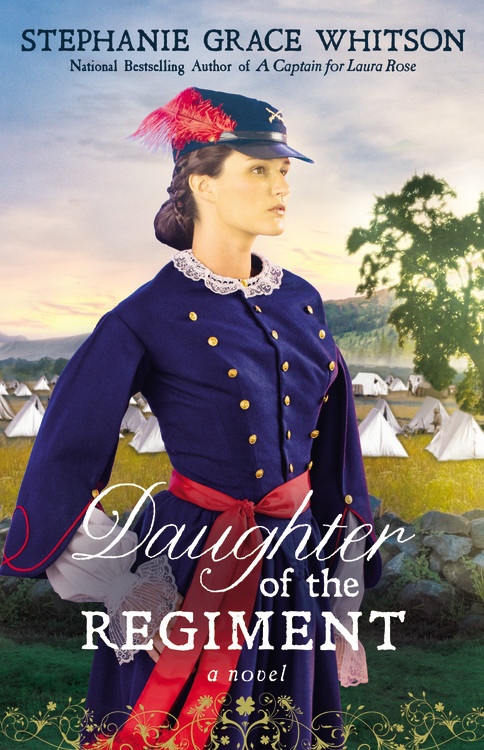
Daughter of the Regiment: A Cover Story

Daughter of the Regiment: A Cover Story

http://bit.ly/1GDs9UC
Order Daughter of the Regiment from
Christian Book Distributors at:
http://bit.ly/1GDs9UC

"He held up the blue blanket--which was not a blanket at all, but her blue wool cape, adorned with gold buttons and red braid ..." 


Lovers of historical fiction tend to share a fascination with historic costume. We spend time on Pinterest oohing and aahing over the gorgeous creations housed in costume collections around the world. Some of us even attend Civil War reenactments and Jane Austen balls in costumes we’ve made. While we do love our “women in costume,” I suspect we’ve secretly thankful we aren’t expected to lace up a corset and step into five petticoats every morning!

A great deal of thought and planning goes into cover design for any novel, and when a publisher takes extra care with selection and planning, it makes a writer’s heart sing. Sometimes publishers have access to theatrical costume warehouses. That gives them a wide range of options for a cover shoot. In the case of Daughter of the Regiment, FaithWords went the extra mile. They hired a designer to make a uniform inspired by an authentic Civil War vivandière costume housed in the National Museum of American History. (Vivandières were women who served the French army during the Crimean War. Their service inspired Daughters of the Regiment in the American Civil War.)  

Vivandière Uniform
Division of History of Technology,
National Museum of American History

          That’s Maggie Malone on the cover of Daughter of the Regiment. Maggie is a 6-foot-tall Irish immigrant who farms alongside her two brothers and her uncle. When the Civil War breaks out, she has very little interest in a conflict “the Americans” should solve. But when Maggie’s two brothers volunteer with the Irish Brigade, and when one of their names shows up on a list of wounded soldiers, war becomes personal. Worried about her brother, Maggie travels to where the Irish Brigade is encamped. Eventually, she begins to think of the soldiers as “her boys.” As the story unfolds, Maggie grows and changes, until she realizes that she doesn’t want to leave the regiment. In the end, Maggie follows in the footsteps of 19th century women like Kady Brownell of Rhode Island and Annie Etheridge of Michigan.
          Historic photographs of women who served as Daughters of the Regiment show various versions of uniforms. Soldiers who wrote about regimental“daughters” mention caps decorated with feathers, bloomers, and all manner of braid. Inspired by the Smithsonian’s vivandiere’s costume, designer Linda Coulter first sketched the design shown at left. Once FaithWords gave approval, she created this exquisite uniform of soft blue wool, complete with authentic Civil War era reproduction buttons and lace. The jacket is fully lined and boned. Maggie Malone would have been proud to wear it, and I’ve been excited to share it with readers who attend launch events this spring. If I could wear it, I would … but alas, it’s a size 0, and I am not.

          I hope you’ve enjoyed learning “the inside story” of this cover shoot. You can see more historic background on my Pinterest Board,  https://www.pinterest.com/stephgwhitson/daughter-of-the-regiment/

Tuesday, June 2, 2015

God's Promises in Trials


It was the 1990s, and my husband had just been diagnosed with a non-curable (at the time) form of non-Hodgkins lymphoma. The children were 16, 14, 10, and 7. An envelop arrived in the mail ... and it did immeasurable good.  (Well, immeasurable by me, anyway. I'm sure the angels are still keeping track.) A reader had sent me a copy of something her pastor gave to people facing tough times. A few pieces of paper stapled together. A promise from the Bible and Scripture illuminating the promise. The verses had been typed out. No effort needed. Just read. Be comforted. Hang on. 

I carried that gift with me for years and referenced it countless times. By God's grace, I hung on. All these years later, that gift still speaks to me personally. But it's gone further. When I speak on the subject "Got Hope?", I offer that hand-out ... with a slight change. I encourage others to select the verses that are most meaningful to them ... in the version they are most familiar with ... and then to write those out so that they, too, will have a lifeline ready when it's needed. No effort. Just read. Be comforted. Hang on.

So today, I offer the content of that hand-out below, along with a few of my favorite verses. But you will find your own.

 "Now may the Lord of peace Himself continually grant you peace in every circumstance." 2 Thessalonians 3:16

God's Promises in Trials

ALL THINGS WORK TOGETHER FOR GOOD

          Romans 8:28-39            2 Corinthians 4:16-18
            Philippians 4:19             Ephesians 1:22-23
            2 Corinthians 9:8           2 Timothy 4:18
            Ephesians 1:13-14         I Peter 5:6-7
            John 1:16-17
                   
OUR LIFE IS NOT OUR OWN

          Colossians 3:1-3            I John 5:4-5
            Ephesians 2:6               John 5:24
            Galatians 2:20               John 16:33
            I Corinthians 6:19-20

GOD HAS NOT GIVEN US A SPIRIT OF FEAR

          2 Timothy 1:7               John 3:17-18
            I John 4:18                   2 Corinthians 3:17
            Luke 12:25-26               Psalms 118:5-6
            Matthew 6:31-34           Hebrews 4:9-10
            Psalms 34:4                  Matthew 6:25-26
            John 14:27                    Philippians 4:6-7
            Matthew 10:29-31

WHEN WE ARE FAITHLESS, HE IS FAITHFUL

          I Corinthians 1:9           Matthew 6:28-30
            I Corinthians 10:13        Hebrews 6:17-20
            Hebrews 10:23              James 1:5
            2 Timothy 2:13              Romans 5:3-5
            Hebrews 13:5-6             John 6:35
            2 Thessalonians 3:3      Psalms 68:19

WHEN WE ARE WEAK, HE IS STRONG

          2 Corinthians 12:9-10    Isaiah 30:21
            2 Corinthians 1:3-4        I Peter 1:6-7
          Hebrews 4:16               Ephesians 3:20-12
            Matthew 11:28-30         James 1:2-4

          2 Thessalonians 2:16-17    Jude 1:24-25                 
           Ephesians 3:12

Wednesday, April 15, 2015

Christian Fiction Scavenger Hunt STOP #4 (Pink Team)


I hope you enjoyed this spring's event! The contest has ended, but there's no reason not to enjoy author Beth White's post below about her new release, Creole Princess. Happy Monday!

Welcome to the Christian Fiction Scavenger Hunt! I am a part of TEAM PINK and this is Stop #4. 

[If you’re just joining us, there are two loops—pink and purple—and they begin at Lisa Bergren’s site http://lisatawnbergren.com/2015/04/christian-fiction-scavenger-hunt-stop-1-purple-team/ and Robin Hatcher’s site http://www.robinleehatcher.com/christian-fiction-scavenger-hunt-stop-1-pink-team fhttp://www.robinleehatcher.com/christian-fiction-scavenger-hunt-stop-1-pink-team for stop #1 for either stream.] If you complete either the pink loop or the purple loop, you can enter for a Kindle paperwhite and the 17 autographed books from that loop. If you complete BOTH loops, you can enter for the Grand Prize of a Kindle Fire HDX and ALL 34 autographed books (by adding up all the Secret Numbers). So write everything down as you go--if you run out of time, you can return to it later.

The hunt begins at NOON Mountain Time on April 16 and ends at MIDNIGHT Mountain Time on April 19, 2015. That means you have 3.5 days to complete all 34 stops, to enter all individual, pink, purple, and Grand Prize contests, and to maximize your changes for a prize. Winners will be announced on April 20, 2015.

ALSO, please don’t use Internet Explorer to navigate through the loops. Some web sites won’t show up using IE. Please use Chrome or Firefox—they’re better anyway!]
Beth White


Without further ado, it’s my pleasure to introduce you to my guest for the Scavenger Hunt, Beth White. It’s been my personal joy over the years to cheer on Beth’s talented music students (her day job is teaching music at an inner-city high school), and now it’s a blessing to introduce you to her books.

Beth is the award-winning author of The Pelican Bride. A native Mississippian, she teaches music at an inner-city high school in historic Mobile, Alabama. Her novels have won the American Christian Fiction Writers’ Carol Award, the RT Book Club Reviewers’ Choice Award, and the Inspirational Reader’s Choice Award.

Here’s the summary of her latest book, The Creole Princess

Torn between loyalties to family and flag, one young woman is about to discover that her most important allegiance is to her heart.

            It is 1776 and all along the eastern seaboard, the American struggle for independence rages. But in the British-held southern port of Mobile, Alabama, the conflict brewing is much quieter—though no less deadly.
            Lyse Lanier may be French in heritage, but she spends most of her time in the company of the ebullient daughter of the British commander of Mobile. When a charming young Spanish merchant docks in town, Lyse is immediately struck by his easy wit and flair for the dramatic. But is he truly who he makes himself out to be? Spies abound, and Spain has yet to choose a side in the American conflict. Is Lyse simply an easy mark for Rafael Gonzalez to exploit? Or are his overtures of love as genuine as Spanish gold?
            Beth White invites you to step into a world of intrigue and espionage from a little-known slice of the American Revolutionary War.

And here’s her EXCLUSIVE content, that you’ll only find in this hunt!

Five Fascinating People from the American Revolution You’ve Never Heard Of

               I researched the Colonial period for the second book of The Gulf Coast Chronicles, The Creole Princess, I kept running across information that had me thinking, That is amazing!—Why have I never heard of this person before!? Some of those amazing people became characters in my novel, some inspired mixed versions of themselves, and some even triggered major plot twists. Even if you’re not a history nerd like me, I thought it might be fun to introduce some of those folks.
               At the onset of hostilities, England actually possessed fifteen American colonies. We automatically think of the thirteen rebellious colonies located in New England and along the eastern seaboard, but East Florida and West Florida both remained loyal to the mother country until they were invaded by Spain in 1780-1781. Recent release of documents held in Spanish archives reveals the significance of Spanish colonial involvement in the American struggle for independence.
               So without further ado, meet my Top Five: Bernardo Gálvez, Feliciana Estrehan, Oliver Pollock, Elias Durnford, and James Willing. Hopefully, these brief introductions will whet your appetite for further study of this fascinating and little-known slice of American history.


Brigadier-General Don Bernardo de GálvezAppointed governor of the Spanish colony of Louisiana in 1777, Gálvez was son of one of King Carlos III’s most trusted military advisors and nephew to respected minster of the Indies José de Gálvez. A strong, charismatic leader, Bernardo demonstrated a genius for secretly funneling funds, supplies, arms and ammunition to the Americans. Via a well-developed network of spies, he gathered, absorbed and disseminated vital intelligence. His strategy for invading the ports of Baton Rouge, Mobile, and Pensacola succeeded despite catastrophic weather conditions and miscommunication from the chain of command above him. Though he remained a loyal Spanish administrator and military commander, Gálvez held a deep sympathy for the American cause and maintained lifelong friendships with their leaders.

María Feliciana de Saint-Maxent Estrehan—This beautiful New Orleans widow of French-Creole extraction won the heart of the dashing young Governor Gálvez. They married in December of 1777, and Feliciana proved to be a powerful influence in Spanish-American politics during the Revolution.

Oliver Pollock—A merchant of Irish descent who early threw in his lot with the American experiment, Pollock invested his entire significant fortune in the Cause—to the point that he ended up bankrupt and in debtors prison. Only after his death were his debts forgiven by Congress and his status as a major Revolutionary financier recognized. Pollock, appointed as an official agent of the Continental Congress, served as one of Gálvez’s most trusted aides-de-camp.

Colonel Elias Durnford—This cultured and educated British officer and civil engineer laid out the city of Pensacola, Florida, after it was ceded by the Spanish in the 1763 treaty of Versailles. Durnford spent a short stint as acting governor of West Florida until the arrival of Governor Peter Chester in 1770, when he became Lieutenant-Governor. Durnford was tapped to command Fort Charlotte in Mobile during the Spanish invasion of 1780.

Captain James Willing—Willing’s name rates many mentions in the annals of Gulf Coast history, and it appears people either loved him or loathed him. A passionate American patriot, Willing began his career as a merchant in the settlement of Natchez and ended as commander of several lucrative American raids of English plantations along the Mississippi River. He would swarm ashore with his troops, scoop up slaves and anything else salable, and continue to New Orleans, where he would put the merchandise up for auction and funnel the proceeds to the American cause. He also took it upon himself to sail into the British port of Mobile and distribute copies of the controversial Declaration of Independence among the citizens, in an attempt to proselytize—which landed him in the Fort Charlotte guardhouse for an extended period.

* * *

THE SCAVENGER HUNT SKINNY:

Thanks for stopping by! Before you go, make sure you WRITE DOWN THESE CLUES:
Secret Word(s): dangerous.
Secret Number: 99 (chosen because it feels like I rewrite every page of my work-in-progress at least that many times before I'm remotely satisfied with the story)
When you've finished the Pink Hunt, enter for the pink team grand prize here: http://www.robinleehatcher.com/christian-fiction-scavenger-hunt-stop-18-pink-team-entry-form/

Got ‘em down?? Great! Your next stop is #5, Beth White’s site. https://bethsquill.wordpress.com/2015/04/15/christian-fiction-scavenger-hunt-stop-5/. Click on over there now (or look below to also enter Stephanie's bonus give-away). If you get lost, a complete list of the loop with links can be found at our mother host’s site http://www.robinleehatcher.com/christian-fiction-scavenger-hunt-pink-team-authors-stops.

BONUS GIVE-AWAY FROM STEPH:

Win both of Stephanie’s FaithWords titles A Captain for Laura Rose and Daughter of the Regiment)
 
PLUS be one of the first to read a copy of Stephanie’s fall novella in the Civil War collection A Basket Brigade Christmas as soon as it’s available this September.


To be entered in the drawing to win, do two things:

1) Click on this link and “like” my Facebook page: https://www.facebook.com/StephanieGraceWhitsonofficial

2) Click on this link and subscribe to Stephanie’s newsletter: http://www.stephaniewhitson.com


That’s it! If you win, Stephanie will contact you by e-mail for a shipping address. Winners will be selected and announced the afternoon of April 20. The drawing has been made. I am awaiting confirmation and will post the winner's name as promised this afternoon.


Saturday, January 31, 2015

The Thomas P. Kennard House in Lincoln, Nebraska

Thomas P. Kennard was Nebraska's first Secretary of State, and his1869 Italianate home is the oldest structure still standing on the capitol city's original plat. The house was open to the public last December, and I loved revisiting. Stepping through the front door was an exercise in time travel to this historical novelist. To get an idea of the "buzz" that this house would have created when it was going up, take a look at the photo to the right, which shows a view of the house from the new state capitol building. Would you say that locating a state capitol in this place was an exercise in faith in good things to come? Can you imagine moving to this treeless plain from Indiana? I wonder at Mrs. Kennard's reaction. I wonder if she ever climbed the winding stair (or ladder) to that cupola and looked East and longed for home. And trees. I wonder if I'd been

I love taking advantage of the opportunity to see this lovely old homes and to imagine the lives of those who lived in them. That's my granddauhter heading up to the front door.

The corbels and other architectural elements on the exterior are lovely ... but I'm glad it isn't my job to keep them painted!

The first thing I noticed stepping inside was how very dim the lighting was compared to what I'm accustomed to in 2015.

Isn't that walnut bed gorgeous? I love everything about this room ... the burled walnut headboard, the hair wreath in the oval frame on the opposite wall ... and the very early treadle sewing machine that is just out of sight at the lower left of the photograph.  The needlepoint upholstered chair is sitting at that machine. I have a needlepoint chair from that era that belonged to Jennie Venetress Kingsbury, my husband's grandmother. I did the needlepoint on the chair, and I can see it just over the top of my laptop screen as I type this blog post.

I have a pair of redwork pillow covers like those on the bed as well that I enjoy sharing with folks when I give a quilt history program. Mine are dated 1869.

And here's something that makes me want to go back to this house ... do you see the date on the drop of the bedcover? I didn't even see that when I was standing in the doorway taking this photograph. Is that date stuffed work? I don't know ... but if my eyes aren't fooling me, that date is 1869. Who made it? For what special occasion? Inevitably, a visit to a house like this fills my mind with questions.

Do you love visiting historic homes? Do you have a favorite memory?


Friday, December 12, 2014

Plum Pudding

As promised in my December 12 blog post over at www.HHHistory.com ... a recipe I honestly cannot imagine taking on. If "beat thirty minutes" didn't ward me off .... "boil seven hours" would! My hat's off to the cooks of old!

Plum Pudding, No. 1
from Manual for Army Cooks, 1896

Note: The above recipe is enough for thirty men.The ingredients of this pudding, with the exception of the eggs and milk, should be prepared the day before the pudding is to be made.

2 qts. sifted flour
2 qts. bread crumbsa
four pounds suet, freed from fiber and chopped moderately fine
four pounds raisins, picked, seeded, chopped, and dredged with flour
sixteen eggs, whites and yolks beaten separately
two qts. sweet milk (or equivalent of condensed milk)
1/4 lb. citron, cut fine and dredged with flour
grated rind of one lemon
1 Tbsp. ground ginger
1 Tbsp. ground cinnamon
1 tsp. ground cloves

Into a deep pan or dish put the ingredients in the following order, incorporating them thoroughly: First, the beaten yolks of the eggs; then one-half the milk; then the flour, bread crumbs, suet, spices, and lemon rind; then the remainder of the milk, or as much of it as will make a thick batter; then the beaten whites or the eggs; and last the dredged fruit.

Beat the mixture for thirty minutes, put it into the prepared bag or bags, and boil seven hours. Serve hot with sauce. 


Monday, December 8, 2014

The Historic Ferguson House in Lincoln, Nebraska

Located just across the street from the Nebraska State Capitol Building, the Ferguson House was built between 1909 and 1911. William Henry Ferguson came to Nebraska from Illinois in 1879 by covered wagon. He helped introduce winter wheat and alfalfa to Nebraska. He owned grain elevators and farms, a creamery, a brick company, and an amusement park (Capital Beach). At a time when an average two-story, three bedroom house cost $3,000-$4,000, the Fergusons' mansion cost about $38,000. It would be the family home until Mrs. Ferguson passed away at the age of 103. Today, the home is a working office for the Nebraska Environmental Trust. I visited this past Sunday for a Christmas Open House and was totally entranced by the grandeur that is still evident in every room. Here are a few photographs.
Welcome to the Fergusons!
The stairs that lead up from the foyer just inside that lovely front door.
Stained and leaded glass windows frame the fireplace in the large formal living room.
Mahogany in the formal dining room.
One of two Mission (or Craftsman?) style bedrooms
Architectural details fascinate me.
This is in the master bedroom.

Up and Up and Up to the third floor ball room.
What secrets might have been shared between couples
having a little tete-a-tete in those cozy little niches?


My mother was a maid, so I'm always
interested in the servants' areas of
a grand home. This is the servants'
staircase. Two maids had rooms up on the
third floor. A docent said that the butler
had quarters over the carriage house.
I didn't get a photo of the carriage house,
but it's still there--and beautiful.
And the inner front door. Look at that "bent" wood framing the
glass panels. So graceful.

The north side of the house. The door opens into the formal parlor.

Next door to the Ferguson House is the Kennard House, an Italianate style mansion built in 1869 for the first Secretary of State in Nebraska. Photos forthcoming!